Creators, Affiliates, and Influencers: What Role Does Each Play for Brands in 2026?
December 3, 2025•6 min read•Affiliate Marketing

Author
Rabii Babou
CEO & Co-Founder, Livano Agency
As a performance-driven agency working with fast-growing eCommerce and DTC brands, we’ve tested every variation of influencer, creator, and affiliate strategy across Shopify, TikTok Shop, and broader social commerce.
And one foundational truth always emerges:
Brands that scale the fastest are the ones that build systems. Not just campaigns.
That’s why we were excited to collaborate with UpPromote, the largest affiliate platform for Shopify and a partner we deeply respect. Their insights come from supporting over 150,000+ brands, which gives them a macro-level view that very few companies in this industry ever get to see.
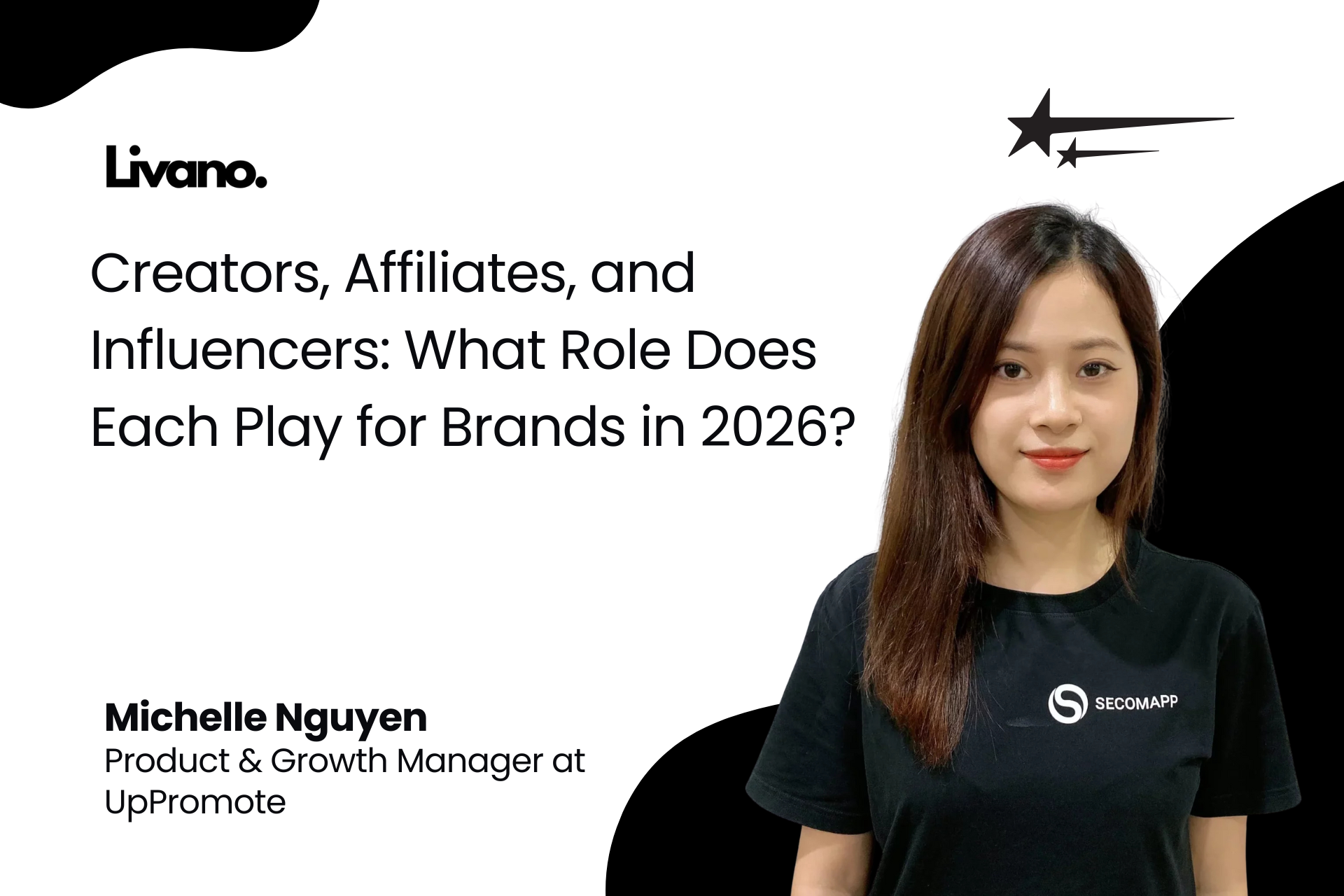
For this collaboration, we invited Michelle Nguyen, Product & Growth Manager at UpPromote, to share her expertise on how creators, affiliates, and influencers will each shape brand growth in 2025 — and how forward-thinking brands should evolve their partner mix.
Everything from this point onward is authored by Michelle Nguyen (UpPromote), including the examples, data, and analysis.
You can also find Michelle’s full profile and headshot included below, exactly as provided by the UpPromote team.
Creators, Affiliates, and Influencers: What Role Does Each Play for Brands in 2026?
(This section forward is presented as written by UpPromote’s team.)
The affiliate marketing landscape has fundamentally shifted in 2025. Working with over 150,000 eCommerce brands at UpPromote, we've watched brands shift from choosing between partner types to strategically combining them all.
This reflects a fundamental change in how successful brands approach growth. Brands are increasingly building hybrid programs that combine creators, affiliates, and influencers to optimize different stages of the customer journey. What's happening isn't a replacement. It's evolution toward strategic partner mixes where each type plays a specific, measurable role.
The Evolving Landscape: Three Roles Redefined for 2025
Creators: The Trust Builders Winning Budget Share
Creators produce in-depth content: YouTube reviewers, detailed bloggers, TikTokers explaining products, podcasters diving deep. They excel at authentic storytelling and nurturing audience relationships.
What's changing: Only 49.2% of brands plan to increase traditional influencer spend in 2025, down from 59.4% in 2024. Meanwhile, the creator economy is projected to reach $480 billion by 2027. Brands are shifting budgets because creator content delivers lasting value. A YouTube video can drive engagement for over 8 days, while Instagram posts typically peak within 19 hours.
From what we see across our merchants, creators with smaller but highly engaged audiences often drive more revenue than macro-influencers with larger passive followings. The difference? Audience intent. Creator followers are actively researching products, not just scrolling for entertainment.
Influencers: Awareness Engines Adapting to Performance
Influencers bring reach and social proof at scale. They excel at product launches and rapid awareness building.
What's changing: The shift toward accountability. More influencers now use trackable links and accept performance-based elements. The numbers are compelling: nano-influencers (1K–10K followers) drive 1.73 percent engagement rates compared to just 0.61 percent for macro-influencers.
Affiliates: The Conversion Specialists Getting Smarter
Affiliates are performance-driven: review sites, comparison platforms, coupon aggregators, and customer referrals. They capture bottom-funnel buyers ready to purchase.
What's changing: Strategic segmentation. Leading brands now differentiate between coupon sites (capturing existing demand) and educational affiliates (creating new demand) with intentionally different compensation approaches.
Building Hybrid Programs: Combining All Three
The highest-performing brands in our platform build strategic mixes across the customer journey:
Top of Funnel: Influencers create awareness and social proof
Middle of Funnel: Creators build trust through detailed reviews and educational content
Bottom of Funnel: Affiliates drive conversion through competitive offers and discount codes
A consistent pattern we observe: Successful brands compensate coupon sites differently (lower rates, customers already decided) compared to creators and educational affiliates (higher rates, bringing in new customers). This aligns compensation with actual contribution.
Real-World Examples from UpPromote
FlasKap: Strategic Segmentation in Action
FlasKap runs one of the most strategically designed programs we've seen. They manage approximately 200 affiliates segmented into five distinct groups based on their role in the customer journey.
Their approach is intentional: coupon sites and product reviewers focused purely on conversion earn standard commission rates. Ambassadors and influencers who actively educate audiences and build brand awareness earn meaningfully higher rates.
UpPromote allows creating multiple programs, enabling FlasKap to run separate affiliate programs for each segment. Each program has its own commission structure, onboarding flow, and promotional materials.
Breeze eSIM: Scaling Across Multiple Partner Types
Breeze eSIM works with a diverse partner mix: travel bloggers functioning as creators, comparison websites serving as traditional affiliates, and strategic partnerships with major platforms like Booking.com.
Their commission strategy is sophisticated, including:
- Tiered commission levels
- Product-specific commission adjustments
- Country-based payment variations
Today, their affiliate partnerships drive 30 percent of total transactions.
UpPromote’s automation and flexible structures make this type of segmentation possible.
Neonic Pickleball: Creator-Led Growth
Neonic Pickleball focused on micro-creators with highly targeted audiences instead of celebrity endorsements. They partnered with YouTube reviewers and engineers who produce detailed paddle reviews and breakdowns.
This creator-led strategy now accounts for 70 percent of their revenue.
UpPromote’s auto-generated coupon codes made tracking effortless and attribution accurate.
Five Success Factors for Hybrid Programs
Michelle outlines five patterns that consistently appear in the highest-performing affiliate programs:
- Segment partners by role and align compensation
- Automate operations to enable scale
- Recruit for engagement, not just reach
- Build infrastructure for multiple partner types from day one
- Enable direct communication and performance transparency
Looking Ahead: The 2025 Playbook
According to UpPromote’s data, brands that will scale the fastest in 2025 are those who:
- Use affiliates for bottom-funnel efficiency
- Use creators for trust and content longevity
- Use influencers for rapid awareness
And — importantly — use all three in combination.
The difference between modest results and breakthrough growth isn’t the number of partners.
It’s the systems, segmentation, tracking infrastructure, and operational sophistication behind those partners.
UpPromote continues to play a pivotal role by giving brands the automation, tracking, and multi-program structure needed to manage a hybrid ecosystem at scale.
Closing Remarks
I want to personally thank Michelle and the UpPromote team for sharing these insights with our readers. At Livano, we see many of the same patterns in our work in affiliate marketing — and it’s incredibly valuable to align our field experience with UpPromote’s data-driven perspective.
If you're a brand operator, I can’t recommend strongly enough that you consider UpPromote’s ecosystem as a foundational part of your affiliate and creator strategy.
Ready to build your hybrid affiliate program? Install UpPromote for free and start combining creators, affiliates, and influencers in one platform. Join 150,000+ brands scaling through strategic partnership programs.
If you’d like support designing or scaling your own hybrid affiliate program, our team at Livano is always happy to chat.